 UK
UK IRE
IRE AU
AU CA
CA US
US ZA
ZA NA
NAExpert financial copywriter
Renamed the Growth Guarantee Scheme, the government’s extension of the Recovery Loan Scheme launched on 1 July 2024, supporting UK businesses with lending of up to £2 million

Page written by Arabella McAvoy. Last reviewed on October 2, 2026. Next review due April 6, 2027.
The UK Government’s Growth Guarantee Scheme (GGS) is a continuation of the popular Recovery Loan Scheme, with lending of up to £2m.
When comparing GGS to its predecessor RLS, the terms remain broadly unchanged, except for interest rates. Find out how much you could borrow with our Growth Guarantee Scheme calculator.
On April 13 2025, the Chancellor announced that the Growth Guarantee Scheme (GGS), an evolution of the Recovery Loan Scheme, originally set up to support the UK’s small businesses during the pandemic with government-backed lending, will provide around £500m of additional lending capacity in a bid to boost SMEs across the UK.
This extra funding is intended to ease the cashflow issues of businesses affected by changes in global tariff rates
As per the Recovery Loan Scheme (RLS), lending can be in the form of term loans, overdrafts, asset finance, and invoice finance.
The maximum facility size is still £2 million for businesses in Great Britain and £1 million for those inside the scope of the Northern Ireland Protocol. The British Business Bank will continue to administer the scheme on behalf of the Secretary of State for the Department for Business, Energy, & Industrial Strategy (BEIS).
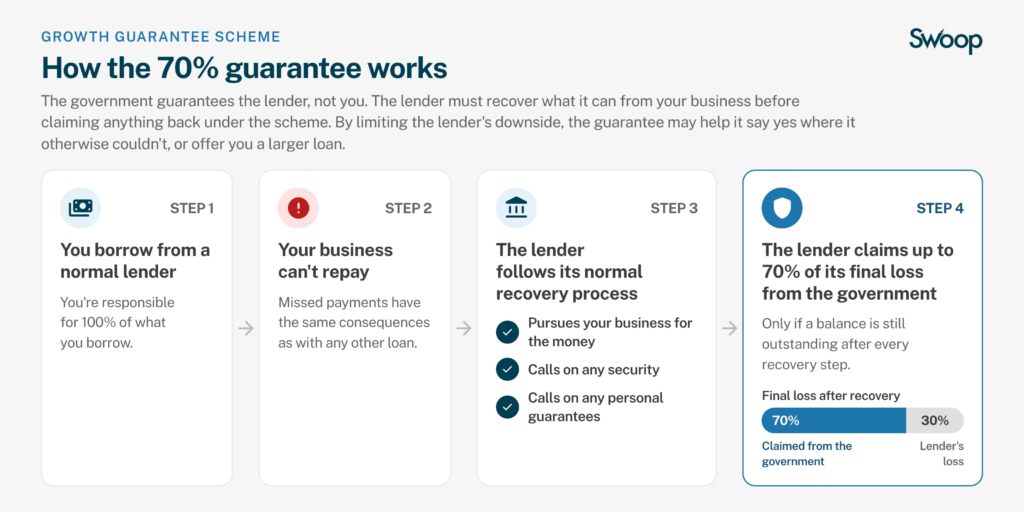
Under the Growth Guarantee Scheme, as with RLS, the government guarantees 70% of lending to each eligible business. In other words, the government underwrites 70% of what the lender could lose if a business defaults. Businesses are still liable for 100% of the borrowing.
The eligibility criteria are also unchanged – most importantly borrowers need to have a maximum turnover of £45 million.
While GGS aims to improve the loan terms available to UK businesses, these terms reflect the protection that the 70% government guarantee offers to lenders (e.g. interest rates will typically be higher). It is worth noting that some businesses might be able to find commercial loans with better terms by registering with Swoop.
It’s also worth registering with us if you’re looking to refinance any existing loans, e.g. loans you took out during the pandemic, or if you need extra cash to realise your growth plans. We’ve made it really easy for you to find out what finance options you might qualify for, whether it’s a startup loan, a loan to cover your VAT bill or a short-term loan to support your working capital.
Ahead of her Mansion House speech on 14 July 2026, Chancellor Rachel Reeves announced the largest expansion of the Growth Guarantee Scheme since it launched – a £6.5 billion uplift the government calls the most significant reform to small business finance in years.
Here’s what’s changing:
What’s not changing: the maximum facility stays at £2 million, and the government guarantee to lenders stays at 70%.
The new terms will roll out through the scheme’s accredited lenders. Register with Swoop and we’ll let you know the moment the wider terms are available to your business.
Businesses can apply for a loan under the Growth Guarantee Scheme directly through a number of accredited lenders, or with the help of a broker like Swoop.
The GGS isn’t a loan product, and it isn’t something you can choose. The lender decides whether to use it, and it should only do that when it can’t offer you the same or better terms without it. Here’s what happens:
GGS covers term loans, overdrafts, asset finance and invoice financing.
What people often think | What’s actually true |
|---|---|
“It’s government money.” | Lenders lend their own money. The government only covers part of the lender’s loss if a business can’t repay, and only after the lender has tried to recover the debt. |
“It protects me if things go wrong.” | The cover is for the lender, not you. You’re 100% liable for the funding, and any personal guarantee can still be called on. |
“It’s cheaper.” | Not usually. Lenders use it where they see more risk, so it can cost more than their standard offer. If a lender can offer you better terms without the scheme, it should. |
“It means no personal guarantee.” | Lenders can ask for one on any size of facility. The fixed protection is that your main home can’t be taken as security. |
“It’s the new Bounce Back Loan.” | The Bounce Back Loan Scheme was an emergency Covid scheme with a fixed low cost. It closed in 2021. The GGS works on normal commercial terms. |
“Government-backed means easier approval.” | You still need a viable business that passes the lender’s normal checks. The scheme can stretch a lender’s appetite. It doesn’t lower the bar. |
The scheme works for strong businesses with one specific gap. The most common is the one in the example at the top of this page: a business that can afford more than its security supports. Here are three other situations where it can make the difference.
A lender likes your business, but its credit team can’t quite approve it on standard terms. Maybe profits dipped last year, or your business credit score is lower than it would like. The guarantee reduces the lender’s risk enough to make an offer it otherwise wouldn’t.
A bank will lend, but only with a charge over your home. Under the GGS, a lender can’t take your main home as security, and the guarantee may give it enough comfort to lend without it. You’d still need to meet the lender’s criteria, and a personal guarantee may still apply.
Your business has steady revenue and good credit, but you don’t have property or savings that would make a personal guarantee meaningful to a lender. The government guarantee can stand in for some of the security you can’t give.
These are illustrative examples. Every lender sets its own criteria and makes its own decision.
Term lengths depend on the type of finance (product) you choose. Under the Growth Guarantee Scheme, lending terms can extend to:
The Growth Guarantee Scheme started on July 1st, 2024 and will end on March 31st, 2030.
The government declared 2024 as “the year of the SME” in February as it re-opened the Help to Grow campaign, opened a small business council, and extended (and renamed) the Recovery Loan Scheme by nearly two years. The Growth Guarantee Scheme will run until March 2030 and will enable an estimated 11,000 smaller businesses to access the finance they need.
The government’s measures announced in 2024 came with a clear acknowledgement of the importance of UK smaller businesses to the economy:
“Almost every business in the country is a small business (99.9%) who in turn support 27 million jobs across the UK, accounting for £4.5 trillion of annual turnover – which is why the government is making 2024 the year of the SME.”
The aim of the Growth Guarantee Scheme is to provide a vital support to smaller businesses across the country.
The GGS scheme is essentially an extension of the third and final iteration of the Recovery Loan Scheme and is ‘broadly unchanged’, according to the British Business Bank.
Businesses can borrow up to a maximum of £2 million (per business) for all types of borrowing, i.e., term loans, overdrafts, invoice finance and asset finance.
This £2 million maximum remains the same as it was for the Recovery Loan scheme, for businesses in Great Britain. The maximum is still £1 million for those inside the scope of the Northern Ireland Protocol.
Businesses in Great Britain can apply for:
Businesses inside the scope of the Northern Ireland protocol can apply for:
A business needs £450,000 to finish a project and take on more work. Its revenue comfortably covers the repayments, but it doesn’t have enough assets to secure that much, so the lender will only offer £300,000.
Under the GGS, the government covers 70% of the lender’s loss if the business can’t repay. With less of the risk sitting with the lender, it may be able to offer more, getting the business closer to £450,000 or matching it in full. And if the lender does ask for security, the owner’s main home can’t be part of it.
The business still has to pass the lender’s normal checks, and it’s still 100% responsible for repaying everything it borrows.
Why this works: the gap here is about security, not affordability. If the lender had capped the amount because the business couldn’t afford bigger repayments, the scheme wouldn’t change that.
When comparing GGS to its predecessor RLS, the terms remain broadly unchanged, except for interest rates. Find out how much you could borrow with our Growth Guarantee Scheme calculator.
Your loan details
This calculator is intended for illustration purposes only and exact payment terms should be agreed with a lender before taking out a loan.
Your results
Monthly payments
£
Weekly payments
£
Daily payments
£
Avg. monthly interest
£
Total interest
£
Total cost of finance
£
Apply nowThe following types of business are eligible for GGS:
Businesses have to meet certain criteria in order to access the scheme. To be eligible, your business must:
Three more things to note:
While the Growth Guarantee Scheme is widely available to UK businesses, there are some exceptions:
The following are not eligible:
Yes, sole traders are able to apply for the Growth Guarantee Scheme.
As long as a business satisfies the other eligibility criteria, GGS is open to:
Unlike RLS, where fees were capped at 14.99%, interest rates and fees for loans under the Growth Guarantee Scheme can differ based on your loan details.
However, lenders must pass on any benefits from the guarantee to your business, after covering their own costs, like the lender fee.
If you’re interested in finding out exactly what rates might be available to you, your first step would be to register with Swoop.
The government guarantee means that if a business defaults on any lending under the Ggrowth Guarantee Scheme, the lender can recoup 70% of the outstanding value of the loan from the government. This guarantee gives lenders confidence to lend to businesses. As the borrower, you are always 100% liable for the debt.
Businesses which successfully apply for Growth Guarantee Scheme finance can do so for any legitimate business purpose, for example:
In general, yes, but there are a few things to be aware of:
The amount you can borrow is capped (£2 million in Great Britain, £1 million in Northern Ireland) at a business group level. This includes any outstanding debt you are holding under CBILS or RLS. So if, for example, one part of the business group based in Birmingham has borrowed £500,000, the maximum amount of borrowing across the rest of the business group must not exceed £1.5 million.
You may use GGS to refinance existing RLS or CBILS loans; refinancing will be considered as a new application for GGS, and subject to meeting the eligibility and the lender’s criteria.
Re-financing can be sought with your existing lender or a different accredited lender.
Existing Bounce Back Loan Scheme borrowers can also refinance under GGS, but you should be aware that borrower protections and scheme eligibility/terms are different from RLS and CBILS. If in doubt, it’s worth registering with Swoop to understand your options.
As you’d expect, businesses with bad credit have fewer GGS options available to them, and the interest rates they are able to secure would typically be higher.
That said, just as with the Recovery Loan Scheme, businesses which have been refused credit in the past might be able to apply for the GGS. Lenders review each application on its own merits, i.e., on a case-by-case basis.
If the GGS is not an option for your business, you might consider exploring business loan options and indeed other finance options available to your business. Register with Swoop to understand your options.
The first two iterations of the Recovery Loan Scheme, which were designed to support access to finance – and growth – for UK businesses as they recovered from the Covid-19 pandemic, supported UK smaller businesses with £4.3bn of finance.
The third and final iteration of the scheme, launched in August 2022, enabled more than £1bn of finance. Approximately 80% of facilities under the third iteration were offered outside of London, and more than 90% of the businesses supported had fewer than 50 employees.
Yes, lenders will carry out a credit check and possibly a fraud check. The types of checks may vary between lenders. If you have been refused credit in the past, you may still be eligible for lending under the Growth Guarantee Scheme.
If your business is in insolvency proceedings, you won’t be eligible.
You must also have a business proposition that is judged viable by the lender to obtain a loan under GGS.
Yes, exporters are eligible for the scheme, but there are strings attached. You mustn’t use the funding to:
If you’re an exporter, you will need to self-certify that you will not use GGS for any of these purposes.
Yes, as long as you meet the other criteria, you can still apply.
Important: If your business is a Northern Ireland applicant, you cannot go over a cap of €15 million of risk finance aid, or risk finance and de minimis aid combined. Relevant risk finance schemes in the UK include the Enterprise Investment Scheme (EIS), Venture Capital Trusts (VCT) and the Seed Enterprise Investment Scheme (SEIS).
So if your business has received risk finance aid totalling more than €14.8 million, you will not be eligible for aid under this scheme.
Not in the way most people expect. With most lenders, you apply for their funding, and they decide whether to use the scheme. Whether your business is eligible for the GGS, and whether it’s suitable for you, is the lender’s call.
A small number of specialist and regional lenders only lend through the scheme. With them, the GGS is the route, but they still decide whether your business fits their criteria.
That’s why asking for “a GGS loan” can narrow your options. It’s usually better to ask for the funding your business needs and compare what different lenders can offer.
Tell us about your business once. Swoop compares funding options from our panel of [300+] lenders, including lenders accredited under the GGS, so you can see cost, speed and terms side by side.
Our funding managers will help you prepare what lenders usually ask for, such as bank statements, accounts and director details. If a lender decides the GGS is the way to fund your business, you’ll see it. If a standard offer works out better, you’ll see that too.
We will keep this page updated as and when the government provides any updates.
There's no fixed price. Lenders set interest and fees based on your business and the funding you need, and they must pass on the economic benefit of the guarantee after their own costs of using the scheme. But because lenders typically use the GGS where they see more risk, a GGS-backed offer can cost more than a standard offer. Comparing options across lenders is the only way to know.
No. The Bounce Back Loan Scheme was an emergency Covid scheme with a fixed low cost, and it closed in 2021. The GGS is priced on normal commercial terms, and lenders assess every application in their usual way.
You might. Lenders can ask for a personal guarantee on any size of GGS facility, if it's part of their normal practice. They can't take your main home as security. If avoiding a personal guarantee matters to you, tell us, because some funding options outside the scheme don't need one.
You remain liable for the full amount. The lender follows its normal recovery process, which can include calling on any personal guarantee. The government only reimburses part of the lender's loss afterwards. It doesn't clear or reduce your debt.
Yes, as long as you meet the GGS criteria and the lender's own criteria, and any extra borrowing is affordable. Some earlier government-backed borrowing counts towards your maximum, which is set at business group level. You can also use the GGS to refinance existing Bounce Back, CBILS or RLS debt, which is treated as a new application.
In some cases, yes. For example, a lender may use the scheme to refinance existing debt to improve your working capital, with or without extra borrowing.
Yes, as long as the funding isn't used to fulfil a direct export order, advertise outside the UK, set up an office, agent or distribution network outside the UK, or make a product only sold outside the UK. You'll need to confirm this in writing.
Yes, if you meet the other criteria. Northern Ireland applicants that have received more than €14.8 million of risk finance aid, including EIS, SEIS and VCT, aren't eligible.
Written by
Arabella is a former BBC business journalist who began her career as a policy analyst at the Bank of England and Financial Conduct Authority, and more recently worked in the communications and policy team at the British Business Bank.


Swoop promise
At Swoop we want to make it easy for SMEs to understand the sometimes overwhelming world of business finance and insurance. Our goal is simple – to distill complex topics, unravel jargon, offer transparent and impartial information, and empower businesses to make smart financial decisions with confidence.
Find out more about Swoop’s editorial principles by reading our editorial policy.
Other government support pages

Get your free Growth Guarantee Scheme quote today
 Apply in minutes
  FREE no obligation, personalised quote
  FCA regulated
  Get quote
 Join the 110,000+ businesses just like yours getting the Swoop newsletter.
Free. No spam. Opt out whenever you like.












Aberystwyth Innovation and Enterprise Campus
Gogerddan Campus
Aberystwyth University
Ceredigion
SY23 3EE
Dogpatch Labs, The CHQ Building, Custom House Quay, Dublin, Ireland
View in Google MapsSuite 801, Level 8, 84 Pitt Street, Sydney, NSW 2000, Australia
View in Google Maps295 Madison Ave, New York, NY 10017, United States
View in Google Maps21 Dreyer Street, Cape Town, South Africa, 7708
View in Google Maps
Swoop Finance Limited helps UK firms access business finance by working directly with businesses and their trusted advisors. We act as a credit broker, not a lender, and do not provide loans or finance products ourselves. We introduce applicants to a panel of lenders, equity funds, and grant agencies based on individual circumstances and creditworthiness.
Commission Disclosure: We typically receive a commission from the finance provider (either a fixed fee or a fixed percentage of the amount you receive) upon successful placement. Different providers pay different rates. For certain lenders, we may have influence over the interest rate, which can impact the total amount payable under your agreement.
Regulatory Information:
FCA: Authorised and regulated by the Financial Conduct Authority as a credit broker (FRN: 936513) and registered as an Account Information Services Provider (Ref: 833145).
ICO: Registered with the Information Commissioner’s Office (Ref: ZA600162); registration can be verified at ico.org.uk.
Company Details: Registered in England & Wales with Companies House (No. 11163382). Registered Address: The Stable Yard, Vicarage Road, Stony Stratford, Milton Keynes, MK11 1BN. VAT Number: 300080279.
Terms: All finance and quotes are subject to status, income, and terms and conditions. Applicants must be aged 18 or over. Guarantees and indemnities may be required. Please refer to our terms and conditions and our complaints procedure for further details.
Clever finance tips and the latest news
Delivered to your inbox monthly
Join the 110,000+ businesses just like yours getting the Swoop newsletter. Free. No spam. Opt out whenever you like.
Thanks for requesting a call back
a member of the team will be in touch.






 yet? Register here!